


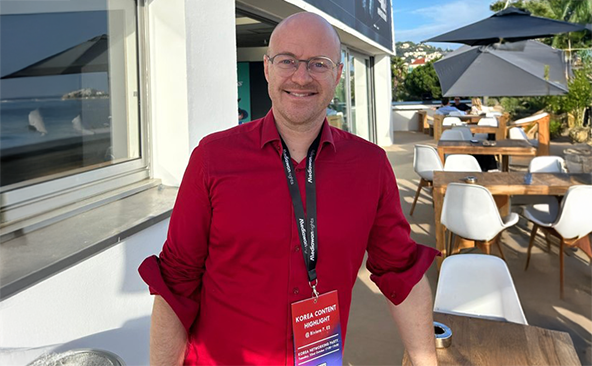
(Interview by Edouard Char for Adweknow at MIPCOM)
Almost everyone knows Côte Ouest. Can you briefly introduce your company?
JL: Côte Ouest has around 25,000 hours of content in its catalog. I say "around" because it's constantly changing. Most of our content is in French and English, but we also offer a smaller selection in languages such as Turkish and Portuguese. Right now, we're closely following the Korean trend. We're starting to take an interest in Korean content so we don't miss the boat. In terms of genres, we obviously have a lot of telenovelas, because we've historically worked with Globo, which is a major partner for us and has a strong presence at MIP right now.
And apart from Globo, who else do you work with?
JL: Côte Ouest is first and foremost a company with African DNA. Historically, we have worked extensively with MultiChoice, a leader in the sector and a major partner in South Africa. More recently, we have started working with CANAL+ for the French-speaking market. This collaboration was established during the year, and we now distribute their "Originals" as well as other titles that are broadcast on A+. CANAL+ wants to maintain its primacy in the French-speaking African market, but they allow us to market their titles outside this area, which is a great opportunity for us and for African producers.
So you distribute all their original productions, is that right?
JL: Yes, we distribute their Originals, as well as all the other titles broadcast on A+, which are often produced by African producers. It's a great deal for us, but especially for the producers. It allows them to generate revenue after the first broadcast on Canal+, which helps them finance new productions and continue to fuel the audiovisual industry in French-speaking Africa.
In terms of production, Mediawan also produces for television channels.
JL: Production is not really Côte Ouest's core business. We are primarily a distribution company. However, we have a sister company, Keewu, based in Senegal, which handles production. They are very active in the field of production in West Africa, particularly in Senegal and other countries. They have worked on major projects, such as Black Santiago Club and Lex Africana, and often collaborate with CANAL+ on local productions. We, for our part, distribute their content.
So you have few production projects at Côte Ouest?
JL: Exactly. We produce very occasionally, when a particular project interests us. For example, we produced the first two seasons of the series Hospital IT, which is set in Togo. We are considering a third season, but we are still looking for the necessary funding. It is a high-quality series, broadcast on TV5 and NewWorld TV, directed by Angela Aquereburu, who is truly an iconic director in Togo. Personally, I appreciate her enormously, both professionally and personally. We hope to be able to distribute this series outside Africa.
Are you able to distribute this type of content internationally?
JL: It's a bit confidential at the moment, but we're very hopeful. It's one of my personal goals: to introduce African cinema to the world. It's cinema of incredible quality, but it's still too little known. Even in Africa, it's often limited to certain areas. Francophone African cinema, for example, struggles to break through in the continent's English-speaking countries. We are trying to build bridges and promote these works internationally. Some series are starting to win awards at international festivals, so the quality is there. Now we need to convince broadcasters to take a chance on them.
Côte Ouest joined Mediawan 18 months ago. What is your assessment of this integration?
JL: The results have been very positive. It took a little time to adapt to the group's standards and procedures, but now everything is working very well. Working with Mediawan provides us with real support, both in terms of expertise and business. Even though Mediawan has less of a presence in Africa than on other continents, they provide us with valuable knowledge about markets outside Africa, which helps us greatly in developing our catalog internationally.
Mediawan has extensive experience in international markets. They know what type of content works on which platform, and they help us target the right distributors for our African titles. This is a real advantage for us.
And what about recent acquisitions?
JL: You've caught me a little off guard there, because I'm at MIP right now with my acquisitions manager, who had to make some acquisitions today that I'm not yet aware of. But generally speaking, we acquire a lot of Globo titles, because they produce a huge amount of content. We're also trying to acquire more African titles, particularly through Canal+ and Mediawan. We've made some great acquisitions from Sony, and we receive proposals from African producers every day. It's a daily task to analyze these offers to see which titles might be of interest to which broadcasters. It takes time, but it's part of our job.
France has recently seen its relations with several African countries deteriorate. How does this affect your business?
JL: Yes, we feel it, especially in countries like Burkina Faso, which is my country of origin. There is a lot of talk about rising anti-French sentiment, but I would say that it is more opposition to French policies than hostility towards the French themselves. In terms of content, there is a real desire in Africa to consume locally, which is reflected in laws protecting the local audiovisual industry. For us, this complicates things a little, because selling titles from one African country to a neighboring country is sometimes paradoxically a challenge, especially when laws favor national production.
There is legal protection, but there is also protection through language. In some countries, vernacular languages are very important, and it can be complicated to sell a French or English title to a channel that will broadcast in Wolof, for example, or in other vernacular languages.
There is also a desire to return to cultural roots, as in Burkina Faso, for example. Burkinabe people attach great importance to consuming Burkinabe cinema. And they are fortunate to have a very high-quality film industry. But as a result, we have a little less added value in that ecosystem.
Did you have to adapt your strategy accordingly?
JL: Yes, we take that into account in our approach. We have to ensure that the content we offer is tailored to the tastes and expectations of local audiences, while complying with the legislation in place. This pushes us to refine our marketing and better target our customers.