


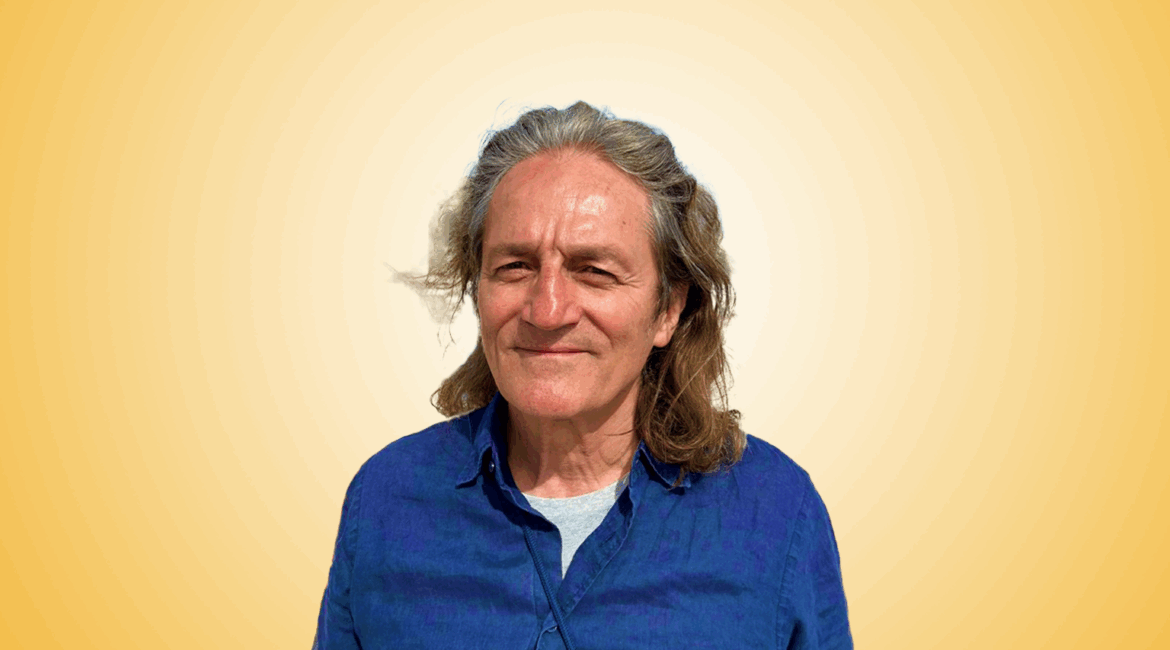
Charli Beléteau is a French author, screenwriter, showrunner, and director.
He co-wrote the television series "C'est la vie" with the renowned Ivorian comic book writer Marguerite Abouet, and trained dozens of African talents in the process.
Interview by Edouard Char for Adweknow during the Cannes Series event
Interview with Charli Beléteau:
AWK: Hello Charli Beléteau. You are an author, director, and trainer. You have led a masterclass at Cannes Series and trained many screenwriters in Africa. Where are you today in this training work?
Charli Beléteau: I do training work directly in the field. In every project I've done with Africans, I've always wanted to train writers so that they can write and produce the episodes that have been commissioned. For example, with Marguerite Abouet, we worked a lot on the series C'est la vie, a program with 26-minute episodes. We filmed several seasons and trained a total of around 30 screenwriters during the first three seasons.
Subsequently, for another series that was more demanding in terms of writing, I recruited writers from various French-speaking West African countries. We conducted on-site training to write 14 episodes of 45 minutes each, over a period of a year and a half, through a dozen workshops. A dozen screenwriters were trained on this occasion.
AWK: So, these are not academic courses?
CB: No, we act on a case-by-case basis, in the field, depending on the development budgets we manage to raise.
AWK: With which partners?
CB: With Marguerite Abouet, we worked with Keewu, a company run by Alexandre Rideau and recently acquired by Mediawan. Funding came mainly from CFI, the French Development Agency (AFD), and other donors. Alexandre, who had experience in NGOs, was familiar with financing mechanisms. This inspired him to create an audiovisual production based on this dynamic. The donors wanted to include messages about sexuality, the place of women in society, polygamy, etc., and we conveyed these messages directly in the stories and dialogues without it being sponsored.
AWK: How were the screenwriters selected?
CB: We used to post calls for applications on the CFI platform when it still existed. After screening the applications, around 10% of candidates were selected. This applied to both writing and directing.
AWK: So the series C'est la vie came about thanks to this initiative?
CB: Yes. It's a series with 26-minute episodes, and over 100 episodes have been filmed. We trained a lot of screenwriters, technicians, and directors. There were also crash courses on two-camera filming, directing actors, etc. We also tried out many different approaches and rehearsed with actors who, in many cases, had never acted before.
For technicians, the setup was pretty much the same. We tried to find technicians who were still in training, but we paired them up with professionals who knew the job a little better.
Over five years, we have trained more than 500 people, from writing to interpreting.
AWK: And did these training courses subsequently lead to other job opportunities for the trainees?
CB: Yes. At first, C'est la vie enabled many young talents to find work on other series. Marguerite and I passed the baton after a while, but the momentum continued, and other productions developed in the region.
AWK: How do you see the audiovisual market in West Africa today?
CB: It's progressing well. Canal+ has greatly boosted local production, as has the emergence of small channels and online platforms.
It's clear that the arrival of Canal Plus International, with the creation of the A+ channel, provided work for a whole network of writers and talented individuals, and enabled technicians to gain more and more training, since there was work to be done: it was through working that they trained themselves.
In Africa, there are schools that offer training in audiovisual professions, but they do not necessarily have the necessary resources and are too few in number to meet the demand.
Furthermore, national television stations still produce very little, with the possible exception of RTI, but budgets are still too limited to achieve unbeatable quality.
AWK: And what about TV5Monde?
CB: TV5Monde and Canal+ are the two pillars of the development of French-language African fiction. TV5Monde, which used to pre-purchase, has become a co-producer, just like Canal Plus, but with fewer possibilities.
Canal+ focuses more on series and produces around ten per year, I believe, while TV5Monde remains a generalist channel with only a few co-productions per year. But they also pre-purchase local series in Cameroon, Burkina Faso, Senegal, and Ivory Coast.
TV5Monde supported us from the very beginning on Wara, moving from pre-purchase to co-production.
AWK: Has your approach changed since you started working in Africa?
CB: My goal remains to work in the French-speaking world, with all the cultural richness that this represents. My desire is to work in the French-speaking world because it is culturally rich and incredibly open in terms of topics, writing styles, etc.
Sharing with authors who are very different from one country to another, who all speak the same language but have different cultures, is really great.
What interests me is being able to talk about my experiences living through all these adventures in West Africa and also being able to give these series the means to exist outside of Africa, on the African continent.
The Wara project was the first international recognition for an African series, as it was presented at Série Mania.
AWK: So you hope that African series will be able to reach audiences beyond the continent?
CB: That's the idea. If we can sell series outside Africa, it will enable us to diversify funding and improve production quality. I would like to be able to work with other French-speaking African writers from West Africa to write a series that would be seen both on the African continent and in Europe, for example.
Today, I am developing a new project that will combine storylines set in Ivory Coast and France. I hope that this project will be able to show the connection between these two continents.
AWK: Are you working with an African author?
CB: Yes, we are still writing with Awa Ba, whom I had already met during the Wara writing workshops. She has a beautiful writing style. It's a project that combines fashion, Africa, and Paris, a true cross-cultural perspective.
We have completed the first phase and are working with a very committed producer. We have just finished a writing residency in La Rochelle and will soon be presenting the project to foreign distributors.
AWK: Do you feel that your training efforts have been successful and that there is now enough talent in place to develop a real serial production industry?
CB: That's a good question, but no, quite the contrary. We always need to bring new talent to the fore. Fortunately, there are now a few local organizations such as Kourtragemé in Dakar. These are people who give a lot and who are looking for talent and bringing it to the fore, which is wonderful.
There is also the experience in Benin with the government, TV5MONDE, and Mediawan.
I myself continue to train young authors, currently in Bangui, Central African Republic.
I work there with young people who are really interesting, who have a genuine perspective on their society and today's world.
I met a young university student who is writing a story about junk food in a country where malnutrition is very prevalent, and she writes it with incredible humor. It's really interesting because she started writing without knowing how to write a sitcom, without ever having written a script before. Obviously, it's a bit chaotic at first, but it's not complicated to learn how to write: it's like math, you have to know how to set up the proof and it works well. I love doing that: breaking new ground, opening up new horizons in places where you wouldn't think it could exist.
AWK: So you are optimistic about the future of African audiovisual media.
CB: Yes, absolutely. These countries have so many stories to tell. Tomorrow, they will bring us powerful and new narratives.