


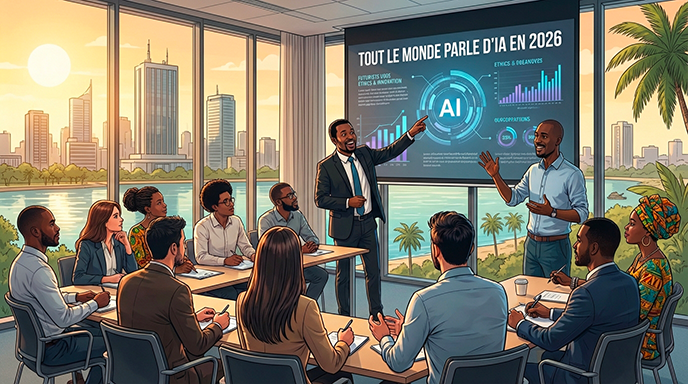
A continent that is accelerating
Africa is not lagging behind in AI—quite the contrary. According to McKinsey (May 2025), the large-scale deployment of generative AI could represent up to $103 billion in annual value for the continent. More than 40% of African organizations are already experimenting with these technologies. Morocco has signed a partnership with Mistral AI, Côte d'Ivoire has secured $100 million for its digital transformation, and the number of AI-specialized companies in Africa has jumped 240% in four years.
For content creators, the opportunity is immense. The explosion of podcasts, web series, and YouTube channels in French-speaking Africa is creating a growing demand for local, high-quality content. But producing more, better, and faster with limited budgets requires mastering new tools: ChatGPT to speed up writing, Midjourney to create visuals without a graphic designer, Runway or Kling to generate video sequences without a post-production studio.
The real challenge is not technology, it's training.
The tools are accessible—many are free. But knowing that ChatGPT exists is one thing; writing a prompt that produces a usable result is another. The Ernst & Young report (end of 2025) on the tech ecosystem in French-speaking Africa is clear: more than 70% of those surveyed point to the lack of appropriate training as the main obstacle to the adoption of AI.
The good news is that barriers to entry have never been lower. Many free or low-cost training courses are now available online, from any country. Platforms such as Coursera offer courses on AI and machine learning designed by the world's leading universities, with courses accessible without prerequisites. Brilliant, for its part, allows users to learn the fundamentals of analytical reasoning and data science through interactive exercises—a valuable foundation for understanding the mechanisms behind AI tools. For a content creator in Dakar, Abidjan, or Douala, all they need to get started is an internet connection.
To go further and move on to practical application, specialized organizations offer certified, hands-on training courses in prompt engineering, image generation, AI-powered video creation, and editorial workflow automation. This type of program, focused on real-world use cases, bridges the gap between the theoretical knowledge acquired online and the operational skills that professionals need on a daily basis.
An issue that goes beyond productivity
The issue is also cultural. AI models are mainly trained on English-speaking and Western data. If African creators do not take ownership of these tools, there is a risk that the continent's narratives will be shaped by algorithms that do not reflect its realities. Training professionals means giving them the means to control these technologies rather than being controlled by them.
Several observers note that African SMEs integrate AI tools in two to four weeks, whereas their European counterparts take four to six months. This agility is a decisive advantage. A content creator in Senegal or Ivory Coast who starts training today—beginning with free resources and then moving on to professional training—can, tomorrow, produce content comparable to that of a European agency, at a fraction of the cost. The time to train is now.
To go further
Coursera (www.coursera.org) — Free courses with certificates in AI, machine learning, and data science.
Brilliant (www.brilliant.org) — Interactive learning of fundamentals: logic, data science, and analytical reasoning.
Elessar Labs (www.elessar-labs.com) — Certified professional training in generative AI: text, image, video, Microsoft Copilot.