


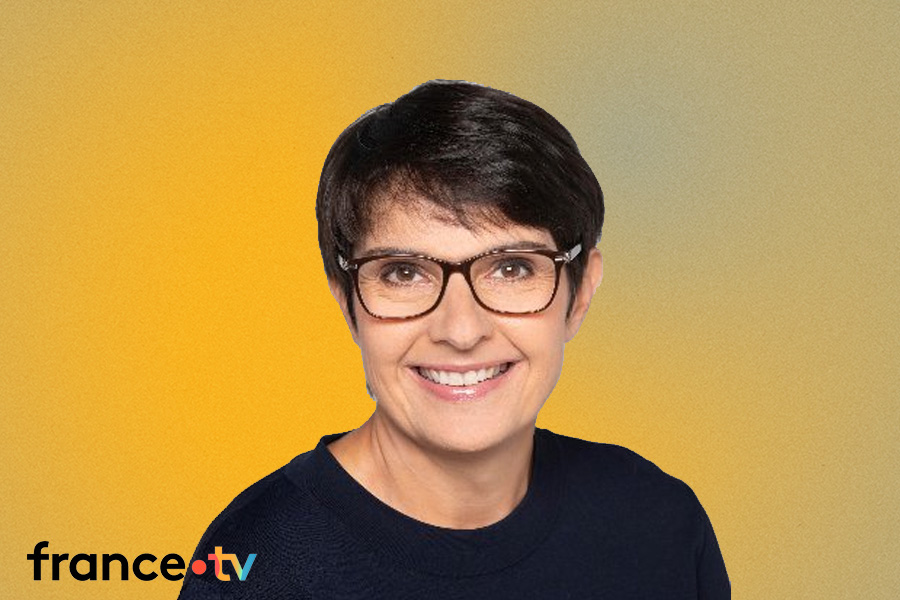
Thank you for welcoming us to your MIP booth. Could you start by describing your development strategy for French-speaking and possibly English-speaking Africa?
Our policy is never to work exclusively with any operator or in any territory. France Télévisions' mission is to implement the widest possible deployment within a legal, organized, and planned framework. We do not refuse to work with anyone who wishes to distribute France Télévisions channels, and of course, our channels can only be broadcast on a paid basis.
Naturally, West Africa and all of French-speaking Africa are historic home turf for us, but for several years now we have also had a strong presence in Portuguese-speaking Africa, in Angola and Mozambique. The last territory to conquer remains English-speaking Africa. We have a small presence there through our agreement with CANAL+, but it's true that we would like to intensify our deployment there.
Would it be fair to say that your business model is based on both direct sales and agreements with operators?
We never sell directly. We always rely on operators because our business model is based on retransmitting our signal. We never do B2C, but exclusively resale agreements with pan-territorial players such as CANAL+, Startimes, and more recently New World, or local operators such as ZAP for Angola and TéléStar for Niger.
And with CANAL+, do you have a single deal or a contract for each territory?
We have a single deal for mainland Africa and, at the same time, we have an additional contract for Madagascar and Mauritius and yet another contract for the Caribbean and Haiti. All these contracts are multi-year and the collaboration with CANAL+ is going extremely well because it is a long-standing partner with whom we get on very well.
Can you give us an idea of France Télévisions' initialization and audience in Africa?
When it comes to audience figures, the data is difficult to obtain. However, there are a few research companies that have set up on the continent, such as Kantar, which measure television audiences using one-to-one questionnaires. For our part, we prefer to work with information based on subscriber numbers, as operators are contractually obliged to report the number of subscribers receiving our channels to us on a monthly basis.
This allows us to know roughly how many people in each territory receive the channel and potentially watch us.
Overall, across the three continents where we operate—Europe, Africa, and the Middle East—we are present in around 60 countries and have a total of 55 million subscribers.
TV5Monde and France 24 also have an international presence, particularly in Africa. Do you work in coordination with them?
They are our cousins, so we have a strong subsidiary agreement. Nevertheless, each has a well-defined mission. In fact, France 24 has a very good local presence in Africa in terms of news, while TV5 broadcasts generalist content, which includes some of our programs, and also has a long-standing presence. And we are really present, explaining that we offer the opportunity to watch television as if you were in France. This allows us to provide access to French public service broadcasting under local market conditions. As I said, whatever happens, we have an obligation to pay because we have to remunerate rights holders for our territorial expansion, whereas France 24 is an international initiative whose rights are entirely free worldwide.
French-speaking Africa is going through a lot of turmoil at the moment. Is this affecting your business?
It is indeed a delicate moment in history, but what is certain is that precisely because we remain a generalist offering and a public service offering as proposed in France, we have a neutrality that allows us to continue to be present in countries where other French media have been shaken up or even forced out—temporarily, I hope.
What is also important for us is to continue to tell the people who have been watching us for a very long time that access to television and France Télévisions' offerings is permitted and that it is important and rather enjoyable to continue watching it.
The fact that you do not produce specifically African content protects you in a way, but could you also be affected by this type of measure through capillary action?
That's not the case, but it could happen. I really believe that since we don't have a physical presence with offices on the ground, there's a kind of distance and a slight detachment… And then it's touching, but when you travel around that part of Africa, people still talk about Antenne 2 and FR3. There is something cultural and historical that has created a bond with the people of West Africa.
For example, Sunday morning religious programs are fundamental for many people.
Overall, what share of your business does Africa represent compared to other continents?
We are really gaining ground: Africa now accounts for just over a third of our business.
But we are forced to remain within a somewhat restrictive legal framework and can only evolve with usage patterns. That is why we recently came up with a flexible product that hosts our channels, which we have called France Télé GO. Initially, we had imagined it with two Os, because we wanted to "keep an eye open."
It is a mobile application managed by operators in the countries where we are currently deploying it. We started with Orange Tunisia last February and are continuing our approach to operators to get them to include this application in the stores they manage themselves. We then launch the offer to each operator's subscribers, at market conditions. For example, in Tunisia there are daily, weekly, and monthly subscriptions, and we offer a monthly subscription for €3 per month.
Our goal is to sign contracts by the end of the year with three to five additional operators with whom we are in contact in Morocco, Mauritius, etc. We are doing this work in collaboration with Orange because, as with CANAL+, there is a French brand logic, and Orange is a company that is very well established in Africa with autonomous subsidiaries that we now know very well.
Are there any other issues that are important to you?
Another of our missions is to revive educational principles, in particular with the LUMNI platform, which is a free, internationally accessible website that is a useful resource for both teachers and students. This is one of France Télévision's tools that we need to highlight and promote.
Comments collected by our correspondent Edouard CHAR