


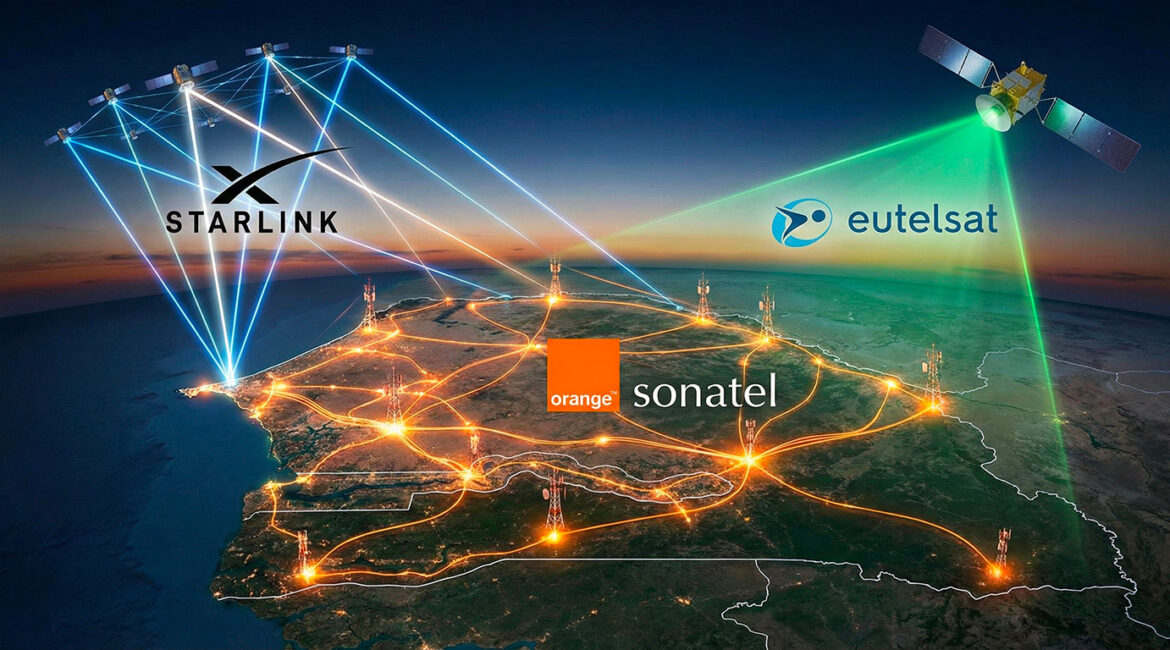
In Senegal, the most advanced country in French-speaking sub-Saharan Africa in terms of internet connectivity in major cities, a new front has just opened up to improve coverage across the entire country.
For several years now, the Senegalese authorities have been committed to reducing the digital divide between Dakar, where almost the entire population has access to the Internet, and other major cities and the rest of the country, where connectivity remains poor or irregular. This disparity hinders education, access to information, the development of small businesses, and the functioning of local public services. The Internet has become an essential service that should be accessible to all. However, traditional technologies such as fiber optics and mobile antennas are not always sufficient: laying cables over long distances and installing infrastructure in sparsely populated areas is very costly for operators.
It is in this context that satellite solutions are returning to the forefront, with the promise of sending the signal from space to a small antenna installed at the user's home or in the center of a village.
In this landscape, STARLINK, billionaire Elon Musk's satellite internet service, and incumbent operator SONATEL-ORANGE, backed by European group EUTELSAT, are making headway with their satellite internet offerings.
STARLINK has built a network of thousands of small satellites that orbit the Earth and send internet signals directly to antennas at homes, businesses, and institutions.
The STARLINK service is already available in several African countries, including Nigeria, Kenya, Mozambique, Rwanda, Malawi, and Zambia. It has also been launched in Benin, with a monthly subscription of 30,000 CFA francs and an initial equipment fee of 400,000 CFA francs.
SONATEL-ORANGE is taking a different approach, but with the same goal: to expand internet access via satellite. To do so, it is relying on a partnership with EUTELSAT, a European group specializing in telecommunications satellites. Unlike STARLINK, which controls the entire chain, EUTELSAT does not sell subscriptions directly to the general public; it provides satellite capacity that operators use to build their own offerings.
Thanks to EUTELSAT's satellites, SONATEL-ORANGE can offer locally managed services, with a physical presence, on-site teams, points of sale, and after-sales service rooted in the country. For some, this represents a more manageable model: the space infrastructure is international, but the relationship with the end customer remains in the hands of a well-known national player. This configuration allows for a strong national presence: the incumbent operator remains at the heart of the system, in contact with the regulator, the government, and the local telecoms ecosystem.
In early December 2025, SONATEL-ORANGE launched the first unlimited satellite internet offers, in partnership with EUTELSAT, at a rate of 30,000 CFA francs per month for households and 44,900 CFA francs for businesses.
In this new competitive environment, the arrival of STARLINK in Senegal has sparked numerous reactions. The unions at SONATEL-ORANGE, as well as those at other operators such as YAS and EXPRESSO, have expressed numerous reservations and demanded clarification on the regulatory framework surrounding this arrival.
The Director General of the Telecommunications and Postal Regulatory Authority (ARTP), Dahirou Thiam, sought to clarify STARLINK's status in Senegal, stating that the satellite operator is fully subject to the national regulatory framework, in the same way as all other players in the telecommunications sector. However, this has not put an end to the debate.
Several questions remain: what type of license has been granted, for how long, and with what commitments to the government and consumers? Where will the data be stored? Who will have access to it? What guarantees are in place to protect citizens' privacy?
Between STARLINK and the satellite offerings provided by SONATEL-ORANGE and EUTELSAT, Senegal finds itself at a crossroads. These solutions can reduce the digital divide and connect the most isolated areas, provided that competition is regulated, transparent, and serves the public interest. The challenge is not only technical: it also concerns digital sovereignty, data protection, and the choice of a development model in which global innovation must contend with the strength of local players.