


The sports rights market has undergone a dramatic transformation worldwide and in Africa in just four or five years. This change has been marked by the disappearance or weakening of certain long-standing players, the emergence of newcomers—notably digital giants—and a profound technological revolution that is redefining the broadcasting and consumption of sports broadcasts.
Three key players
To simplify, the sports rights market revolves around three main types of players: rights holders, broadcasters, and sports rights agencies, which are intermediaries specializing in the marketing of these rights. It is a potentially very lucrative business, but also an extremely risky one.
1. Beneficiaries
A sports right corresponds to a commercial contract between a broadcaster and a rights holder, who is the actual owner of the sports content. The rights holder may be a federation, league, association, or private company, depending on the sport and competition in question.
In Africa, the Confederation of African Football (CAF) holds the rights to major pan-African competitions such as the Africa Cup of Nations (CAN) and the African Nations Championship (CHAN).
FIFA and UEFA own the rights to competitions such as the Champions League, the Europa League, the FIFA World Cup, and the FIFA Club World Cup, which is currently underway.
Other rights are held by commercial companies such as the Premier League, which manages the rights to the English championship, or the NBA, which markets the rights to American basketball worldwide.
2. Diffusers
To maximize their revenues, rights holders have gradually segmented their offerings, reduced contract lengths, and marketed rights by territory or language.
Pay TV and Free TV
The first historical segmentation consisted of selling rights by territory (country, language region, etc.). Then, with the arrival of the first pay TV operators, a new distinction emerged between Pay TV and Free TV rights, with the latter being reserved for free-to-air channels.
With significant resources from subscription sales, pay TV operators (CANAL+ Afrique, StarTimes, SuperSport, beIN Sports, New World TV, etc.) generally purchase exclusive rights to all matches across their entire broadcast area.
But under pressure from the public, who were fed up with having to subscribe to watch their national team, rights holders embarked on a new strategy: selling rights by differentiating between types of broadcasters. This is also a way of increasing revenue from the sale of rights.
Public channels (RTS, RTI, ORTM, etc.) and private channels (NCI, TFM, Canal 2 International, etc.) were thus able to acquire free-to-air TV packages, often consisting of a selection of non-exclusive matches.
During the 2023 Africa Cup of Nations, no fewer than three broadcasters simultaneously broadcast live matches in Ivory Coast: CANAL+ CAN on pay TV, NCI, RTI1, and La 3 on free TV.
To protect free-to-air channels, Côte d'Ivoire—the only African country to have implemented such a measure—has drawn up a list of sporting competitions or events of "major importance" that pay-TV channels cannot broadcast exclusively. This regulation exists in several European countries.
Digital platforms, streaming, and IPTV
This balance between free and pay-TV channels is now being challenged by the arrival of digital players:
Amazon Prime Video, DAZN, Apple, Facebook, YouTube, Google, Orange, MTN, and others have begun investing heavily in sports rights in the United States, Europe, and Asia, particularly to attract younger generations and emerging markets.
Africa is not yet affected by this new competition, except when an operator such as DAZN acquires the global rights to a competition, but the phenomenon is set to become widespread.
At the same time, digital piracy linked to IPTV is a major challenge, prompting rights holders and broadcasters to strengthen their technological and legal measures to protect content.
3. Media Rights Agencies
Sports rights agencies, or Media Rights Agencies (MRAs), play a key role as intermediaries. They acquire rights from rights holders—often with a guaranteed amount—and then resell them to broadcasters in order to recoup their investment.
This lucrative yet perilous business has already led to the collapse or restructuring of several major agencies.
MP & Silva, once a key player, was liquidated in 2018 after failing to meet its financial obligations.
Lagardère Sports, which marketed numerous rights in Africa, was sold and renamed Sportfive in 2020, before ceasing all activity on the continent.
In recent years, several Chinese groups have also ventured into this field:
- Wanda Sports has acquired Infront Sports & Media (founded by Robert-Louis Dreyfus).
- Orient Hontai Capital acquired Mediapro in 2018, resulting in the well-known fiasco surrounding Ligue 1 rights.
Today, a new African player, New World TV, has taken up the torch. For the past three years, it has been acting as both a publisher and broadcaster of pay-TV channels, as well as a sports rights agency.
New World TV has filled the gap left by Lagardère Sports by acquiring free-to-air rights to competitions organized by CAF, FIFA, and UEFA, which it then sells on to free-to-air African television channels.
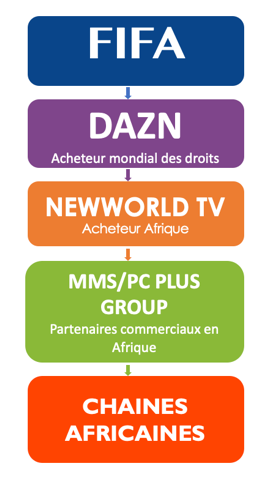
The Club World Cup is a good example of this new complexity:
FIFA sold the global rights to DAZN, which sublicensed them for sub-Saharan Africa to New World TV. The latter relies on MMS and PDPLUS Group to market them to national channels.
A restructuring still in progress
New World TV, which has invested heavily to acquire major soccer rights in Africa, will now face new competition.
CANAL+, the leading pay-TV provider in French-speaking sub-Saharan Africa with over 8 million subscribers, is currently finalizing the acquisition of Multichoice, the market leader in South Africa and English-speaking countries.
Once approved (by October 8 at the latest), this merger will enable the new entity to negotiate on a continental scale, which will complicate matters for New World TV, which currently enjoys a strategic window of opportunity.
An ecosystem undergoing rapid change
The sports rights market has become a complex, globalized ecosystem in which the following intersect:
- Traditional players and new entrants
- Short-term or long-term investment strategies
- Technological innovations
Competition between CANAL+ and New World TV is set to intensify, particularly in soccer, Africa's most popular sport. But other players—from streaming services and digital giants—are also preparing to enter the arena.
The future of African sports rights looks open, fluid, and highly strategic.