


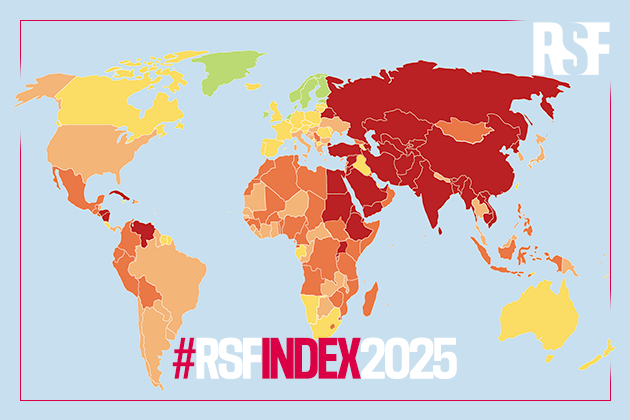
As it does every year, Reporters Without Borders (RSF) published its annual press freedom index on May 2.
RSF 2025 RANKING in French-speaking Sub-Saharan Africa
- GABON – 41st place worldwide
- MAURITANIA – 50th place worldwide
- IVORY COAST – 64th place worldwide
- REPUBLIC OF CONGO – 71st place worldwide
- CENTRAL AFRICAN REPUBLIC – 72nd place worldwide
- SENEGAL – 74th place worldwide
- NIGER – 83rd place worldwide
- BENIN – 92nd place worldwide
- GUINEA – 103rd place worldwide
- BURKINA FASO – 105th place worldwide
- CHAD – 108th place worldwide
- MALI – 119th place worldwide
- TOGO – 121st place worldwide
- CAMEROON – 131st place worldwide
- DRC – 133rd place worldwide
(Source: RSF – processed by Adweknow)
This ranking and the changes noted by RSF compared to 2024 highlight the deterioration of the situation in many French-speaking African countries.
- Guinea: The country fell 25 places, from 78th to 103rd. This decline is attributed to the military regime's growing hostility toward the press, which has resulted in attacks, arbitrary arrests, and death threats against journalists.
- Burkina Faso: The country fell from 86th to 105th place due to increased restrictions on access to information and pluralism, as well as a deteriorating security environment.
- Mali: Mali fell from 114th to 119th place, with one of the worst security indicators in the region, exposing journalists to persistent risks.
- Niger: The country fell three places to 83rd due to a deterioration in several indicators and a worrying security environment for journalists.
- Togo: Togo fell from 113th to 121st place due to the economic precariousness of the media, aggressive taxation, and insufficient public support.
- Cameroon: The country fell from 130th to 131st place, with precarious working conditions for journalists and persistent threats.
In contrast, some French-speaking African countries have made progress:
- Gabon: The country has made a significant leap, rising from 56th to 41st place, making it the highest-ranked French-speaking African country. This improvement is attributed to the end of the transitional regime and the election of a new president.
- Senegal: Senegal has climbed 20 places to 74th position. This improvement is the result of reforms undertaken by the new regime since April 2024, particularly in terms of transparency in the allocation of public aid to the media.
- Central African Republic: The country moved up four places, from 76th to 72nd, reflecting a relative improvement in the situation.
The 2025 RSF ranking highlights a worrying trend in French-speaking Africa, but also in the rest of the world, with press freedom increasingly under threat, particularly due to financial difficulties and a lack of independence.
Let us leave the conclusion to Anne Bocandé, Editorial Director of RSF: "We need to restore a media economy that is conducive to journalism and guarantees the production of reliable information, which is necessarily costly. Solutions exist, and they must be deployed on a large scale. Financial independence is a vital condition for guaranteeing free, reliable information that serves the public interest.
Methodology
The score obtained by each country is the result of
- A quantitative survey of abuses committed against the media and media professionals in the exercise of their duties;
- A qualitative analysis of the situation in each country, measured through the responses of press freedom specialists (journalists, researchers, academics, human rights defenders, etc.) to a questionnaire proposed by RSF in 25 languages.
The questionnaire is divided into five parts, allowing for the calculation of five indicators:
The policy indicator that assesses the degree of support for and respect for media independence in the face of political pressure from the state or other political actors in society.
The economic indicator that assesses economic constraints related to government policies, non-state actors (advertisers and commercial partners), and media owners.
The sociocultural indicator assesses the impact of cultural and social constraints (related to gender, class, ethnicity, or religion) that hinder the free exercise of journalism or encourage self-censorship.
The indicator that assesses the ability to design, collect, and disseminate journalistic information without undue risk of physical or psychological harm or professional prejudice.
The legislative indicator assesses the legal and regulatory environment in which journalists work (level of censorship, ability to protect sources, impunity for violence against journalists).
Read also: The supervision of news media.