


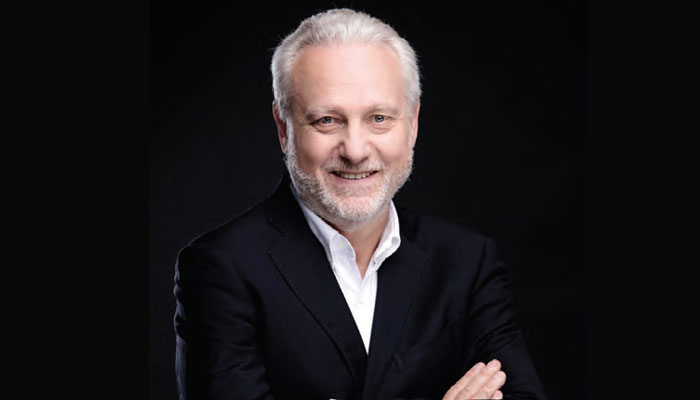
You have just announced your resignation, which will take effect at the end of June. With just a few days left in your term, we would like to focus this interview, if you agree, on your work in French-speaking Africa and on what TV5MONDE is preparing for the continent.
You recently met with African heads of state to work on acquiring stakes in seven countries. How far along are you in the process?
I was mandated by the six governments that sit on the TV5Monde board of directors to meet with the heads of state of the seven African countries that had been approved, in France's case, by the Quai d'Orsay and the Ministry of Culture. We went with Denise Epoté, our Director of Distribution, Marketing, and Sales, to meet with the seven governments in question to present our proposal and see what they thought of it.
We received a very warm welcome in the six countries we visited. I am waiting to meet with the president of Senegal because the presidential elections have been postponed, and I may leave for Dakar this weekend or next week.
What is the content of this proposal?
The proposal is for group membership. In other words, with seven members, it represents one member state.
Why do it this way?
Firstly, because if they joined at 7, they would become the majority. And then, above all, they would not have the means to pay the same amount each year as the Principality of Monaco. So, in fact, we took the Principality of Monaco's contribution and divided it by 7, so that each state could contribute an amount corresponding to its participation in a number of other international organizations.
So these seven African countries are going to create a specific structure?
Yes, based on a tontine principle, which they know by heart: one year out of seven, one of them will represent the other six and will speak on behalf of himself and his six colleagues. And this will be the case both in the Board of Directors and at the Ministerial Conference.
What is the purpose of this capital increase for TV5 Monde?
My thinking, which was heard, accepted, and validated by shareholders, is as follows. When TV5 was created 40 years ago, the French, Belgians, and Swiss wanted to have a place, a television channel where they could talk to each other and broadcast their programs and shared values. Two years later, quite logically, Canada and Quebec joined them. At that stage, the idea was that French speakers in the North would talk to each other and have a television channel that promoted their programs, artists, businesses, and values.
TV5 Monde Afrique was launched because we quickly realized that we couldn't interest Africans exclusively with our programs. So, little by little, African programs and films began to be broadcast, and this trend has grown over the years.
I wrote this in the first strategic plan that I drew up urgently when I arrived here, and which I presented in February 2013 in Quebec City: the 2020s should be the decade when African countries join TV5 because we live in a globalized world and, given Africa's demographics, the French-speaking world and French speakers are mainly located in Africa. We can no longer be just the channel for the French-speaking world of the North.
Does that mean African programs will be included in TV5 Monde, or does it only apply to TV5 Monde Afrique?
No, it's both. We are a global platform, so we will be able to carry programs produced by public broadcasters from all these countries on this platform. We will be able to broadcast some of them on air, as is already the case today since we already broadcast the co-productions we make with them.
But we are going to focus on co-productions. I would like to point out that the additional budget that would be provided by the seven African states will be entirely devoted to Africa. In other words, we will not be asking African taxpayers to pay for Canadian or French programs, or for French staff in Paris, but only for co-productions, for reporters to go to Africa to file stories, for more live broadcasts from Africa, or to cover more events.
And where are you now?
The strategic plan will need to be approved by the Social and Economic Committee, then by the Board of Directors, which is obviously aware of all this and is very supportive.
It will take time. So your successor will take over.
Yes, of course, there is still a long way to go. But we are making progress: tomorrow we will sign a strengthened editorial charter agreement with the Society of Journalists, which had expressed entirely legitimate concerns about the accession of certain countries.
They are concerned that a number of these seven countries, not all of them, but a number of them, do not necessarily respect press freedom, at least not in the same way as the six current states, that there are indeed journalists and opponents in prison in a number of these states, etc.
So we are going to strengthen the Editorial Charter to reassure everyone. We are also going to try to work on how we can better protect correspondents who, as we know, are under pressure.
Why is Africa so important to TV5 Monde?
Yves Bigot: Africa is absolutely fundamental to TV5MONDE. Of our 64 million weekly viewers, more than 50 million are in Africa. Of course, we are present all over the world, but the future lies in Africa. Our future is closely linked to Africa.
to this continent. Our presence in Africa is not new; it dates back several decades. Even in countries where we have experienced temporary interruptions, such as Burkina Faso, we have quickly restored our operations. Africa remains a strategic priority, not only because of its growing population, but also because it is home to our largest audience and it is there that our influence lies, because artificial intelligence will multiply the possibilities for subtitling and dubbing.
Adweknow: What specific initiatives have you taken to create and strengthen this presence?
Interviewee: For more than 32 years, TV5MONDE Afrique has evolved to better meet the needs of its audience. For example, we have transformed our Afrique news program. Initially 12 minutes long, we first increased it to 18 minutes, then to 26 minutes, so that it could become a truly comprehensive news program, combining hard news and magazine segments with guests from the worlds of economics, culture, and politics.
In terms of production, we have stepped up our investments in the African film industry. We have moved from purchasing series to co-producing them. This has enabled many of the films we have supported to be screened at renowned festivals such as Cannes, and even to win major awards. For example, Mati Diop's film "Atlantique," which we co-produced, won the Grand Prix at Cannes three years ago. We are also the global broadcaster of these works, which we show on all our channels around the world and make available on the TV5MONDE+ platform.
Are there also locally produced programs?
Interviewee: We have launched several programs tailored to African realities. In Abidjan, we have "Maternelles d'Afrique," a program focused on family and early childhood education, adapted to the specific challenges of the continent. We also have a health magazine in Abidjan, which addresses local health issues, and a music magazine in Bamako presented by Malian music legend Boncana Maïga. In addition, we have produced economic and historical magazines and programs on women's entrepreneurship in collaboration with the UN. We are now working in animation because our youth channel TIVI is very popular in Africa, with a cumulative audience of 24 million young viewers in the four countries where audience ratings are measured (Senegal, Ivory Coast, Cameroon, and DRC).
These initiatives demonstrate our commitment to reflecting African realities in our content.
How do you ensure that your programs are broadcast in Africa?
We have a hyper-distribution strategy. We are broadcast on several satellites to cover the entire African continent and the Indian Ocean. We also use DTT in many countries such as Congo, DRC, Senegal, and Benin. In addition, we are available on OTT and IPTV, which allows us to reach a wider audience. We collaborate with local public and private channels to produce and broadcast local content. This reinforces our role as an economic and cultural partner, in addition to our position as a global broadcaster of African works on all our platforms, including TV5MONDE+.
Digital technology is also a challenge and an opportunity in Africa. What is your assessment?
of your digital development.
The results are mixed for Africa and good for the rest of the world.
We have increased the number of videos viewed tenfold over the past seven years. We have launched a WhatsApp channel that is working very well and is in line with African consumption patterns.
Regarding our TV5Monde+ platform, which marked the completion of the company's full digital transformation, results in sub-Saharan Africa are more mixed, but it is performing extremely well across the Arab world. The country with the highest consumption is Algeria, followed by Morocco, Egypt, Iraq, and Latin American countries in the top 10.
In sub-Saharan Africa, we could see tremendous progress if, as telecom companies and operators have been promising us for years, they finally lower the cost of data. But I've been here for 12 years, and I've been told that in two years' time, it will be sorted out, but it never is.
But in Africa, there is also the issue of electrification as soon as you leave the cities and urban centers.
We are also very pleasantly surprised to see that we are experiencing very good growth in English-speaking Africa, in countries such as Kenya, Tanzania, and Ghana, where there are no connection issues and where our programs are subtitled in English, Arabic, Spanish, French, etc.
You mention issues related to dubbing and subtitling. How can artificial intelligence promote the development of programs in Africa?
AI plays a crucial role in our strategy for the future. We are actively exploring its potential for subtitling, particularly in African languages such as Lingala, Swahili, Fon, and Wolof.
As far as dubbing is concerned, this represents a major technological challenge, of course, but also a major political one, because we are the channel for the French-speaking world and, as such, our programs must be in French.
I raised this issue at our last ministerial conference in Montreal, emphasizing that AI will ultimately enable us to make our content accessible in many local languages, which is essential to maintaining our relevance and influence. My role is to warn that this is an issue for the short term, for the coming years, but it is a political decision. We cannot avoid addressing this issue, because usage will prevail and our competitors will switch to offering their programs in 50 languages. If we refuse to do so, we will inevitably marginalize ourselves in one way or another.
Finally, do you have any idea when your successor will be appointed?
I happen to know that the governments (editor's note: of TV5 Monde's shareholder countries) are holding a meeting on June 25, as I will be attending it, to present the strategic plan for the next four years and the status of our discussions with African heads of state. That is when they will discuss my succession, which means that my successor should be appointed by July 14 at the latest.
Interview conducted on June 5, 2024