


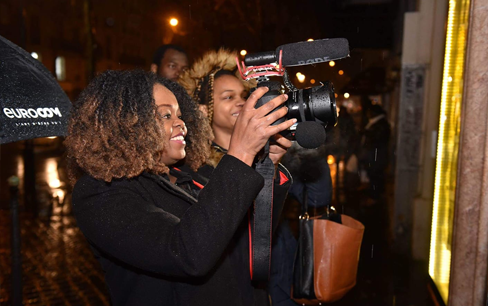
Paulette Fotsing is the co-founder of Wouri Entertainment. After working for several years at Eiffage, she developed a passion for the arts, particularly photography, and then took her first steps into video. Seven years ago, she decided to create Wouri TV with Patrick Kengne Kamga, with the aim of supporting local Cameroonian producers and helping them to make a living from their creations.
What are your activities and what motivated you to create your platform?
Wouri Entertainment is a company founded in June 2016 specializing in the audiovisual field. We combine three activities:
- A production activity with a dual objective: the first being to support local producers in the production of cinematographic works, whether short or feature films, soap operas and series, documentaries, or TV shows. Our support can be financial or technical, through the provision of equipment. We also develop our own content production, drawing on local talent. We have collaborated with partners such as A+ and Nollywood.
- Distribution: this involves marketing content to our TV partners, to whom we sell broadcasting rights under clearly defined terms.
- A film distribution business using our VOD platform. We wanted to give talented individuals visibility by creating our Wouri TV platform, enabling them to make a name for themselves by developing content on social media, and selling this content to partner television channels.
Very quickly, we faced a major challenge: the technical quality of our productions did not meet standards, which meant we were unable to secure broadcasting partnerships with TV channels. One of the biggest problems that was regularly pointed out was the sound quality, which did not meet international criteria. Faced with this situation, I decided to take a course in audiovisual production. This enabled me to acquire all the necessary technical skills. We then shared these essential technical skills by organizing training sessions to harmonize the quality level of productions.
Why is it important for you to support and assist local producers?
We quickly realized that despite the talent of many local producers, very few were able to stand out and bring their projects to fruition. Yet cinematographic works are essential for raising a country's profile and promoting it beyond its borders.
You also market content to TV partners to whom you sell broadcasting rights. Do you have any local partners?
Today, we rely on pan-African partners such as TV5Monde and CANAL+, as well as local channels. Despite this, significant challenges remain, particularly with regard to content.
Why did you choose to integrate an SVOD service? How do you differentiate yourself from the competition?
Today, we are pioneers in Cameroon in terms of VOD, but we need to be able to innovate quickly if we want to survive over time and increase the number of users on our platform. To support this, we have decided to get involved in production. Initially, we embarked on co-production, either in the form of financial contributions or technical support. Gradually, we also developed our own content. This is not yet sufficient, but we are working to further diversify the content and seek it beyond our borders.
Do you have users on the continent? If so, in which countries mainly?
Today, our users are mainly from the diaspora, people who are nostalgic for their local culture and want to reconnect with their country's culture.
Can you tell us more about the Ewusu series project selected by the OIF as part of the Cannes Film Festival?
"Ewusu" means "witchcraft" in the local language. Some time ago, my colleague and I decided to dream bigger and show that we could do even better to meet international standards. We all know that to make a "good film" today, you first need a good script. To have a good script, you also need a good screenwriter. So we decided to set ourselves a challenge: we contacted Françoise Ellong, whose reputation is well established, to write a script.
In Cameroon and Africa in general, it is important to understand that anything that cannot be explained is necessarily attributed to witchcraft, including anything related to psychology, which is still very abstract on a continental scale. The idea behind this project was therefore to contrast African beliefs with Western beliefs in order to highlight the similarities and differences and to "demystify" it all a little.
From a more global perspective, what is your view on the development of production in Cameroon?
We have come a long way, we have evolved a lot. We have made a lot of progress.
"Ewusu" is also the first original creation made in Cameroon. We are very proud of it! We took a lot of risks, but we succeeded, and it's a great achievement. It's our first large-scale project of international quality.