



Closran N’Guessan has been Director of Strategy, Marketing, and Communications for the Life Group, which includes Life TV, Life Radio, and Woman Up, for just over two years. Closran N’Guessan is a product of the Voodoo school, where he spent more than 10 years as Account Director and Group Strategy Planner for six African countries.
Life TV posted excellent results in the latest Médiamétrie ratings, making you the second most popular television channel in Côte d'Ivoire in the third quarter of 2023, behind A+ Ivoire and ahead of Novelas TV and other Ivorian channels. What do you think are the reasons for this success?
The performance in the last quarter is the result of good results built up since the channel's inception. It is not due to a single program or event that would put the channel in the spotlight for a short time.
They stem from a strategic decision to offer programs that will appeal to the average Ivorian.
When we arrived in June 2020, all Ivorian channels naturally emphasized proximity. This is the first attribute that comes to mind when faced with a plethora of international channels.
We also followed this logic, but we decided not to proclaim this proximity as a mere communication strategy.
Our strong results are the outcome of this commitment: to produce programs that truly interest the average Ivorian.
What are your flagship programs?
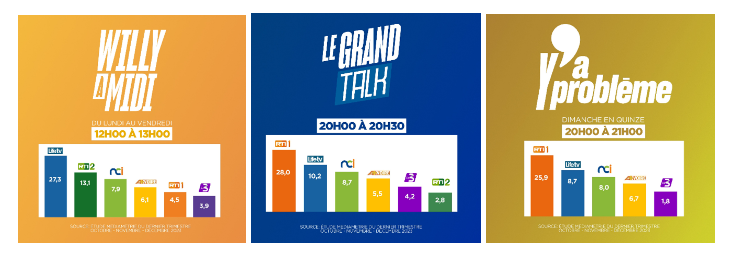
In entertainment, Willy à Midi boasts unrivaled ratings of 27.3 points.
In terms of news and education, Grand Talk, our daily news analysis program, ranks second only to RTI's national news broadcast. The same is true for Y'a Problème, our hard-hitting weekly report.
It was in this ongoing quest for proximity that we decided about a year ago to start producing fiction that reflects the everyday lives of our audience.
For example, the series Isabelle (nominated for FESPACO and NISA awards) tells the story of a young girl who dreams of glitz and glamour, like many young girls and boys in Côte d'Ivoire, and who finds herself caught up in a vicious cycle.
We also produced and broadcast L'Affaire Bomblin, which deals with couples facing separation, and finally Maquisards (7 nominations at the Nuit Ivoirienne du Septième – NISA), which tells the story of the hectic lives of young Ivorians in a neighborhood of Yopougon, which was a huge ratings success in the third quarter (17 rating points for women).
To sum up, we would say that Life TV, unfiltered television, truly understands the average Ivorian, their humor, aspirations, struggles, and hopes, and acts as a true and unvarnished mirror of them. This explains our rise in the ratings.
Which production companies produce these series?
These three series were developed and produced by FS Studios, a production company belonging to the group, in collaboration with Orange TV, and are broadcast exclusively on our channel at 8:30 p.m. Monday through Friday.
When Life TV launched, you invested heavily in reality TV programs. Where do you stand now with regard to this type of program?
Reality TV remains one of the strong elements of our identity, and we are continuing with Jeune MANSA which offers $100 million in financing to young African entrepreneurs, in collaboration with MANSA BANK, and soon season 2 of INSIDE, a reality TV show set in a prison, whose first season was a huge success.
You were the first to purchase the rights to a major sporting event with Euro 2020. Why didn't you go for the latest events such as the 2022 World Cup or the 2023 Africa Cup of Nations?
We did not pursue international sports rights primarily for reasons of economic profitability. Clearly, these events naturally attract attention and audiences, but it is very difficult to make them profitable, especially when the event is broadcast on several channels and you therefore do not have exclusivity.
We preferred to focus on local sports such as Maracana Football with CAM Tchin Tchin or mixed martial arts with AML MMA League.
You mention profitability, which is a real issue for Ivorian channels: we can see that the Ivorian TV advertising market has fallen back to 2019 levels. How do you explain this decline?
For me, there are two main reasons: the recession and the rise of digital technology.
First, the recession: the shock following COVID-19 led to a global economic recession. As a result, major advertisers and multinationals revised their advertising budgets downward. And naturally, this had an impact on us.
The second reason is that today, digital drives practically everything. Even though digital obviously doesn't have the same impact as television, for smaller or less experienced advertisers, it costs less than investing in a medium such as television, even though in reality it is of course not at all comparable in terms of exposure and impact.
Today, digital advertising accounts for a significant share of advertising investment, not necessarily in terms of value but certainly in terms of volume. As a result, there is a lot of educational work to be done in the commercial sphere.
Do you think the market will start to rise again in 2024?
Personally, I don't think it will change significantly.
Especially since we had the 2023 Africa Cup of Nations, and many advertisers—rightly or wrongly—used a significant portion of their budget to advertise during the tournament. It was a very important national event, but much of the buzz was drowned out by the biggest advertisers.
Doesn't this ultimately justify, from the point of view of the networks, investing a lot of money in a one-off event rather than focusing on programs that are hits but don't benefit advertisers?
It's a valid question, but in reality advertisers need to communicate practically every day of the year to publicize their key promotional offers or positioning, and as a mass media outlet we have to support them in this requirement.
Advertisers' budgets are not going to increase dramatically on their own; it is up to the channels to be more creative in order to convince them.
We are at a turning point where we clearly need to reinvent the profession. Private television channels are young, but we will find our way and establish ourselves alongside international and/or more established channels.
There is still no consensus on audience measurement. What is your view on the subject?
Médiamétrie, the agency responsible for this audience measurement, is one of the global leaders in the sector and is a benchmark for many multinational companies operating in our country. In Côte d'Ivoire, its audience measurements have been refined over time in two areas: a larger sample size and a greater number of locations.
That said, it remains important that audience measurement be consensual. There is an initiative by the Ministry of Communication to create a framework for discussion, but unfortunately it is not progressing quickly enough.
Audience measurements are vital for everyone because they bring rationality, validate our strategies, and publicize our performance, especially as young local channels. They provide a reliable compass for all advertisers and the general public.