


As it does every year, Kantar publishes the results of its Africascope benchmark study twice a year.
The results published today cover the entire year 2025.
Consumption across all media averages 6 hours and 41 minutes per day, spent in front of a screen or listening to the radio. This represents a stable audience compared to the 2024-2025 edition, mainly driven by television and the Internet, which account for 88% of media consumption.
TELEVISION
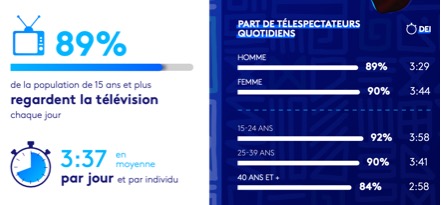
89% of Africans watch television daily, representing 22.2 million viewers with an average viewing time of 3 hours and 37 minutes per person.
The average listening time for women is 3 hours and 44 minutes per day, which is slightly higher than that of men (3 hours and 29 minutes).
The Democratic Republic of Congo remains the country with the highest TV coverage, reaching 97% of the population and with an average viewing time of 4 hours and 15 minutes per day, while Mali is the country with the lowest daily cumulative TV audience, at 63% of the total population and only 1 hour and 46 minutes of viewing time per individual.
RADIO
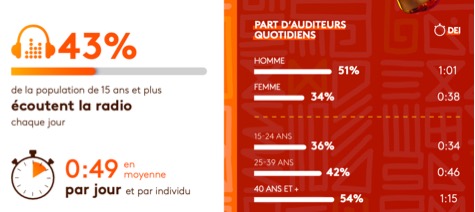
43% of individuals aged 15 and over listen to the radio daily, representing nearly 10.6 million listeners with an average listening time of 49 minutes per individual.
Radio is listened to more by men, with 51% of daily listeners and an average daily listening time of 1 hour and 1 minute, compared to 34% and 0 hours and 38 minutes for women.
Burkina Faso and Mali are historically the largest radio consumers in the region, with coverage of 79% and 63% of the population respectively and average daily listening times of 1 hour 26 minutes and 1 hour 33 minutes.
Radio listenership is at its lowest in Côte d'Ivoire (25%) with an average listening time of only 19 minutes. Two years ago, it was 36% with an average listening time of 39 minutes.
INTERNET
64% of the population connects to the Internet every day.
Across all eight countries, this amounts to nearly 15.5 million daily Internet users.
The average time spent online is 2 hours and 15 minutes per day per person.
Men are more connected than women: 68% of men connect to the Internet every day, with an average connection time of 2 hours and 27 minutes per day, while 60% of women connect, with an average connection time of 2 hours and 4 minutes.
Senegal is the most connected country, with daily coverage reaching 85% of the population for an average consumption time of 3 hours and 8 minutes.
Furthermore, almost all (96%) of the population in large cities in the eight countries studied are registered with a social network.
WhatsApp leads the way with 92% of users, ahead of Facebook, except in Senegal, where TikTok takes second place with 88% of registered users, and in Mali, where TikTok (76%) also takes second place ahead of Facebook (52%).
The use of instant messaging and social networks is following the same upward trend as the Internet in general. Video consumption via SVOD services remains stable and still relatively limited.
Africascope is the benchmark radio and television audience measurement service in Sub-Saharan Africa.
The study covers the capitals of eight countries (Burkina Faso, Cameroon, Côte d'Ivoire, Gabon, Mali, Democratic Republic of Congo, Republic of Congo, and Senegal), representing 25 million individuals aged 15 and older.
The interviews are conducted face-to-face on tablets with a global sample of 11,200 people, representative of the population in the survey area.