


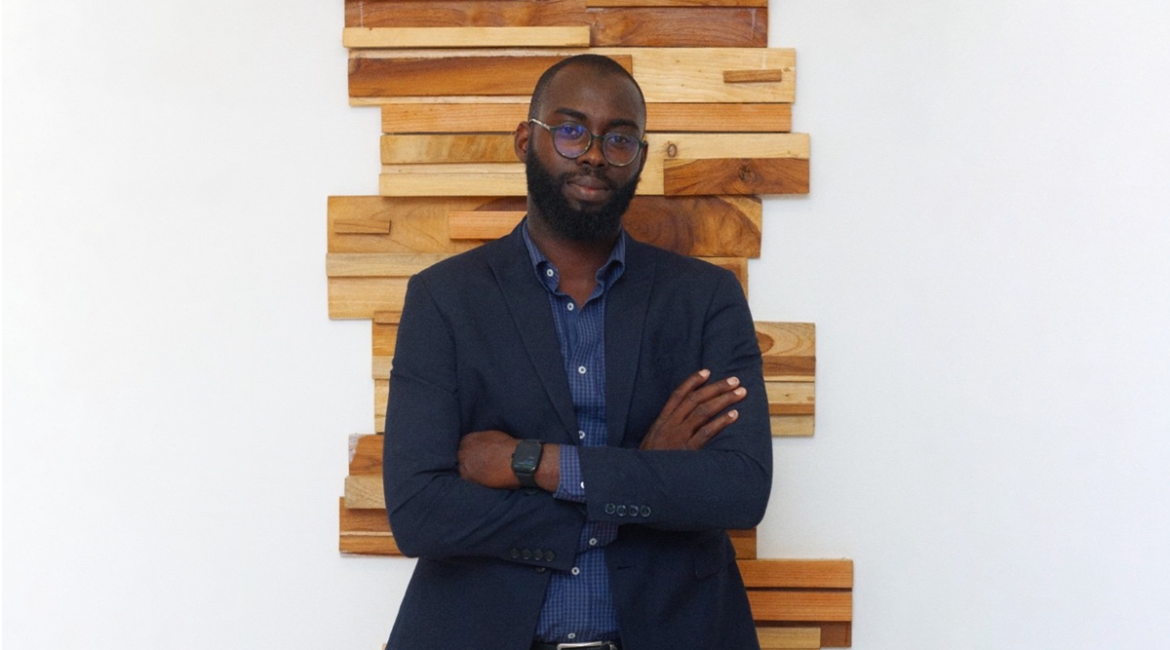
Abdoulaye Amzath, administrator of the Wani Ayo association in Benin.
Comments gathered in CANNES by our correspondent Edouard CHAR.
Your association was founded four years ago in Benin. What initial assessment can you make of these first four years?
The Wani Ayo association was founded four years ago, and over the past four years we have come a long way to get to where we are today.
In 2021, the first action we had to take was to organize a day of reflection in Cotonou, bringing together around fifty professional filmmakers from Benin and the diaspora to discuss the issues…
To take stock of the situation?
Exactly, to take stock of the situation…
During these days of reflection, we identified three issues to be addressed in the medium term. First, training: training has been identified as the key to the development of the film industry in any country.
Benin really wants to develop an industry, but without quality training, this obviously poses a real problem. That is why we have set up the "triptych of film professions" training program, the next edition of which will take place in October.
Next, we advocated for the government to establish a film code, which is obviously struggling to be effective. But without a film code, it will be difficult to protect the rights of Beninese filmmakers.
To this end, we met twice with the Minister of Culture and Arts, who received us kindly and promised, along with his technical team, to work to make this a reality.
In 2024, this has still not been done, but we hope that some things will change in this regard.
Finally, the last point we worked on was supporting young people, because it's one thing to train young people, but it's another to give them opportunities to work on professional sets, and perhaps pick up internships from time to time to gain practical experience of what they have learned or how they have been trained.
In 2023, we had a short training course focusing on acting and set scripting, which is a behind-the-scenes job in cinema, but one that plays a very important and crucial role. And finally, a training course in art direction, which of course encompasses the jobs of costume designer, makeup artist, and set decorator.
In 2022, we trained 22 young people, and in 2023, 29.
Did all those young people find work?
As I said, what sets us apart is that we don't just train people. We follow up with those we have trained: among the 22 young people trained in 2022, we have closely and precisely monitored the professional progress of 15 young people's careers.
In 2023 and 2024, for example, we secured two professional contracts for two young people trained in art direction in Ivory Coast, on the set of one of Canal+'s leading directors, with, of course, the benevolent eye of Fatoumata Kandé Senghor, who was one of the trainers in 2023, in the art direction session.
And in Benin itself, do you have young people who have been able to work on national productions?
In fact, in Benin, what we sadly notice is that there are no real projects that can put these young people we are training to work. There are very few projects in Benin. You can really count them on one hand, but there were three that we put the participants of the 2023 training program on.
But it is mainly outside Benin that there are high levels of cinema, such as Cannes, for example.
And there, in Cannes, this year, what is your goal?
We came to Cannes with a delegation of 15 Beninese film professionals. We have six producers and nine directors in the delegation. There are also actresses/directors present.
The producers who are with us have projects, concrete projects that need co-production. Cannes is actually the hub that allows us to meet with co-producers and pitch their projects as well…
We are truly counting on this momentum, which began in 2021 and continues with Cannes, to lead to truly concrete achievements.
Are these projects for filming in Benin, France…?
If we take the example of a producer like Arnold Setohou, he has projects both for Benin and for Côte d'Ivoire. These are projects for Africa, for countries in the sub-region, but above all for Benin, because you can't call yourself Beninese without having an interest in projects in Benin.
The goal for next year, in particular, is to return not with projects but with films that have been made here?
So that's the ultimate goal… Why not? Why not? We're not setting ourselves any limits because in this delegation we have Kismath Baguiri, a wonderful director who also works in Ivory Coast and who has directed a series called Charles Ornel, which is hugely popular and widely acclaimed, at least in the industry and in Ivory Coast, but especially in Benin.
Canal+ has supported you from the beginning. Where does your partnership with Canal+ stand today?
Canal+ has always believed in us, and I would like to pay tribute to Yacine Alao, the director of Canal+ Benin, who is fully committed to ensuring that young people receive quality training, are supported throughout their various projects, and are able to work in Benin. She is currently investing heavily in the audiovisual sector, as well as in cinema.
Of course, with our partnership with Canal+ renewed in 2024, we hope that things will continue to move forward, and in an even more dynamic way.